Tresky GmbH takes a consistently digital approach to the visual alignment of high-precision DIE bonding processes. The digital beamsplitter eliminates the need for a traditional optical beamsplitter and uses software to combine the images from an up-looking and a down-looking camera. This eliminates additional optical and mechanical parameters in the beam path. This technology also enables alignment tasks where conventional optical systems inherently reach their limits.
In traditional beamsplitter systems, light from different perspectives is combined using a physical beamsplitter. The additional glass required for this is located directly in the optical path and can reduce light output as well as cause reflections, ghost images, or focus shifts. In addition, the mechanical-optical assembly must be precisely aligned.
Tresky follows a different approach
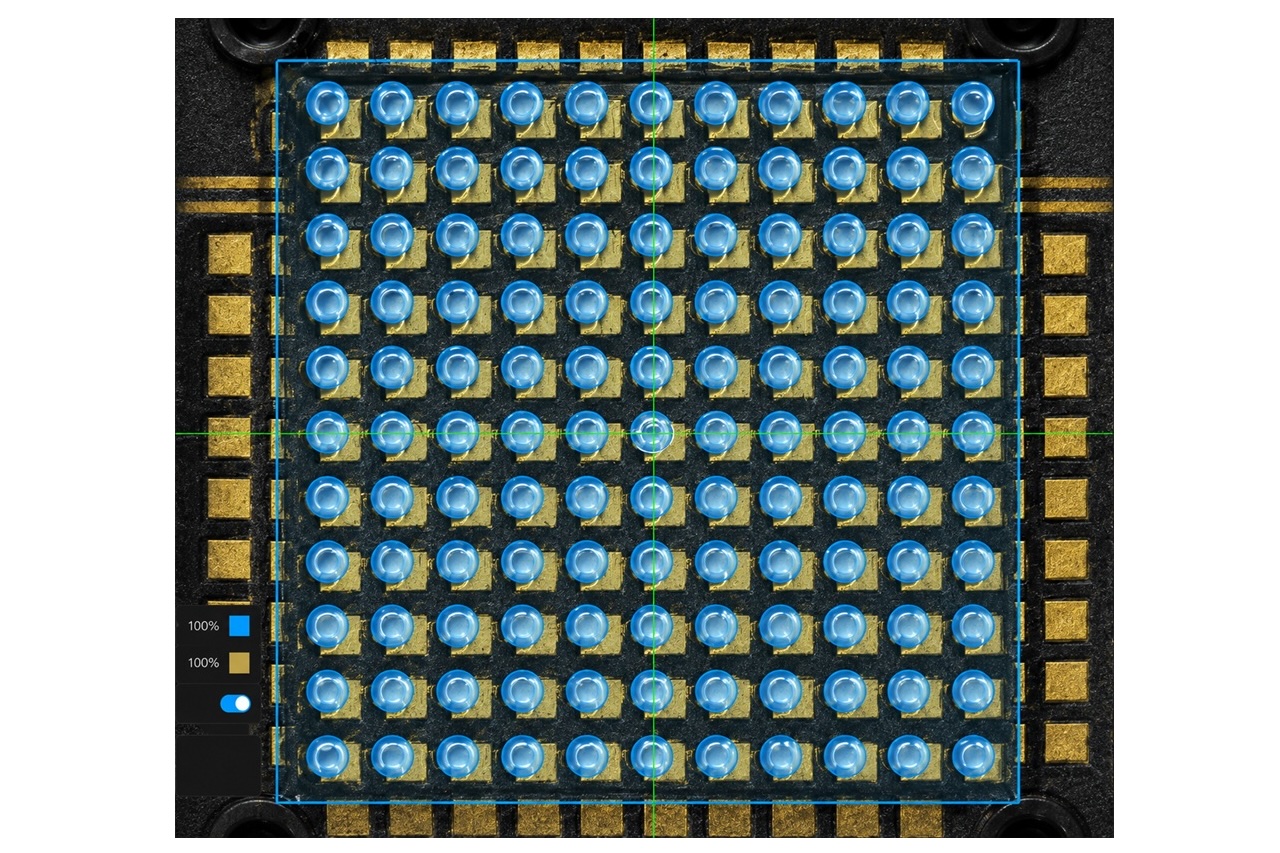
“Why should we still be merging two camera images using an additional piece of glass when we can solve this task more precisely and with far greater flexibility using digital methods?” asks Daniel Schultze, CEO of Tresky GmbH. “With our digital beamsplitter, we’re systematically shifting image merging from the optics to the software.” The upward-facing camera captures the chip, while the downward-facing camera captures the substrate or the target position. Both images are then digitally merged and displayed to the user as a single alignment image.
See and align chips and substrates directly
The user can immediately see the chip structure, the target structure, and the existing misalignment in a single view. Alignment can be performed directly using X, Y, and theta. This means the operator does not have to assess the position solely based on abstract coordinates or indirect image information. Instead, the operator receives direct visual feedback on how the chip and substrate are actually positioned in relation to each other. “We want to provide users with maximum transparency, especially during development, prototyping, and high-mix applications,” says Schultze. “They see the actual alignment situation and can react to it immediately. This gives the customer full control over the alignment process.” This direct visual control is particularly advantageous for complex structures, reflective surfaces, transparent materials, or frequently changing component geometries.
No beamsplitting glass, no light splitting
Since the digital beamsplitter does not require physical light splitting, the light output available to each camera is not split by an additional beamsplitter. At the same time, the cameras’ full sensor resolution can be utilized. Optical effects caused by the additional beamsplitter glass, such as focus shifts, reflections, or ghost images, are also avoided. Likewise, no delicate mechanical-optical adjustment of a beamsplitter prism is required. This allows Tresky to specifically reduce the number of optical and mechanical variables within the alignment system.
The digital image processing also offers significantly greater flexibility. Parameters such as transparency, scaling, zoom, contrast, brightness, rotation, or additional overlays can be adjusted via software to suit the specific application. What is defined by the physical optics in a traditional beamsplitter can be flexibly controlled via software in the digital beamsplitter.
The key difference: Optics can only show what is visible
The technological difference becomes particularly evident in applications where relevant chip structures or alignment marks are obscured by the pickup tool after pickup. A conventional optical system reaches a fundamental limit here: What is no longer physically visible cannot be displayed optically either.
Tresky’s digital beamsplitter goes one step further. The system can capture an image of the relevant chip structure immediately before pickup and save it as a reference. After the chip is picked up, this image is superimposed on the current live image of the substrate. This ensures that a structure that is important for alignment remains usable, even though it is already obscured by the pickup tool on the actual component at that point in time.
“This is exactly where it becomes clear that our digital beamsplitter isn’t simply a digital copy of an optical beamsplitter,” explains Schultze. “We can use information for alignment that is no longer physically visible at the actual moment of alignment.”
More than just a digital replacement for an optical component
Therefore, for Tresky, it is not simply a matter of digitally replicating a traditional beam splitter. Rather, the elimination of the physical beam splitter paves the way for additional functions and new alignment strategies. “The key point does not lie in replacing a piece of glass with software,” says Schultze. “The key point is that software makes things possible that are not possible with a purely optical system.”
This offers specific advantages for users. With the digital beamsplitter, there is no physical division of light. The full resolution of the camera sensor can be utilized for alignment. At the same time, optical effects such as ghost images or focus shifts caused by beamsplitter glass are avoided. There is also no need for the adjustment effort required for a mechanical-optical beamsplitter. The system enables direct visual inspection of the chip and target structure and offers a high degree of flexibility thanks to its software-based image display. Furthermore, previously captured chip structures can still be used for positioning and process control, even if they are physically obscured later in the process.
The Digital Beamsplitter is therefore particularly well-suited for demanding DIE bonding processes in research and development, prototyping, high-mix/low-volume manufacturing, photonics, optoelectronics, and advanced packaging.
Digital alignment instead of optical compromises
With the digital beamsplitter, Tresky consistently pursues its philosophy of combining mechanical precision with intelligent digital process support. “In high-precision DIE bonding, just a few micrometers make all the difference in the process,” Schultze summarizes. “That’s why we want to see as precisely as possible what’s actually happening, while at the same time eliminating unnecessary optical and mechanical variables. The digital beamsplitter gives us exactly that capability.”
About Tresky
Since 2013, the name TRESKY Automation has stood for the highest quality, flexibility and maximum reliability. As one of the world’s leading machine manufacturers for placement systems in the high-precision sector, Tresky GmbH specializes in the development and production of innovative bonding solutions.
The philosophy of Tresky Automation is based on the principle of quality “Made in Germany”. This means that all development, production and sales processes take place at the headquarters. Tresky GmbH is based in Hennigsdorf, a town close to the capital Berlin. This location is not only strategically favorable, but also of great importance, as it is home to numerous highly specialized companies from the automation, electrical and communication technology and life science sectors.