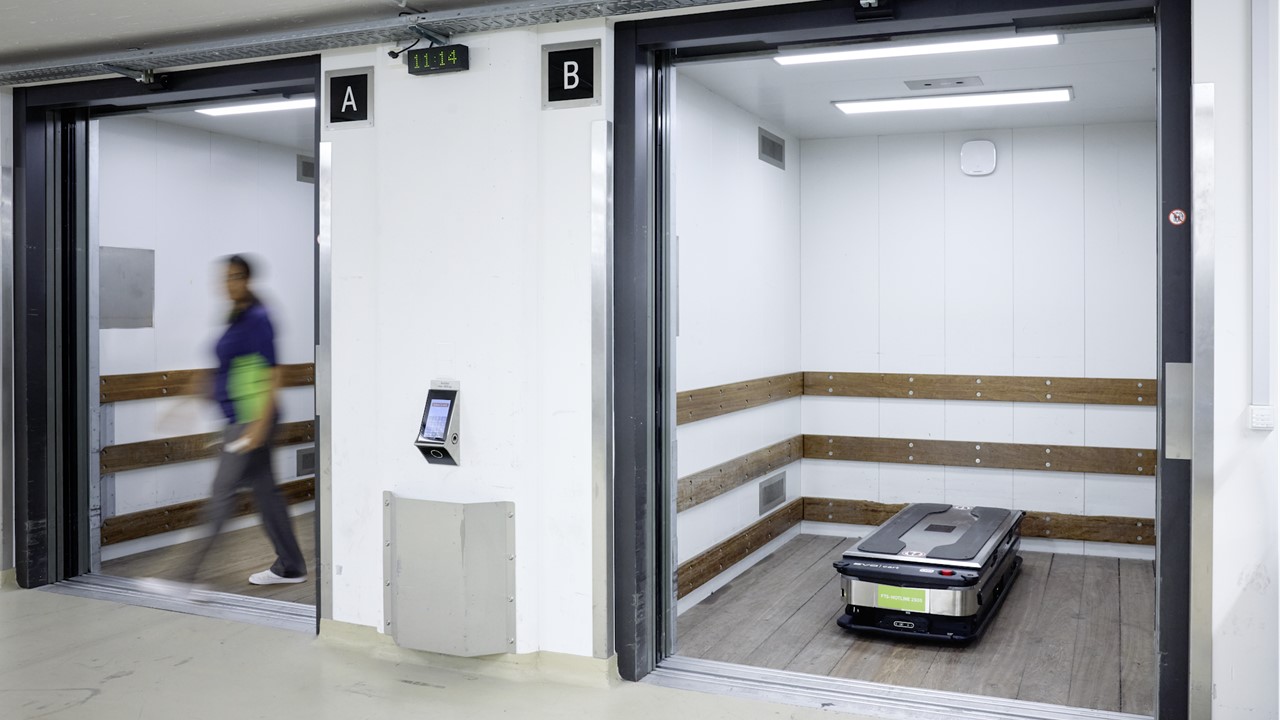
Automated guided vehicles (AGVs) are rapidly transforming hospital logistics, supporting staff by transporting laundry, food, medical equipment, and waste across large facilities. As AGVs become more common in healthcare environments, Schindler is supporting this shift by integrating its elevator technologies and digital solutions with robotic transport systems across hospitals in Europe – including at HOCH Health Ostschweiz in St. Gallen, one of Swizerland’s largest hospital modernization projects.
Modernizing hospital logistics
The newly constructed Haus 07A/B is one of the major milestones of the hospital’s ambitious modernization program. The multifunctional building features a large operating and interventional floor alongside 96 modern patient rooms. Haus 07A has 20 elevators installed, and Haus 07B currently under construction will see six additional units. AGV integration, which had already begun in other buildings across the campus, was added as a new requirement during the project’s implementation. Schindler’s experts responded by expanding the system design and adapting the infrastructure to smoothly incorporate robotic transport.
“All our digital solutions work together in a harmonized ecosystem called Schindler StratOS,” explains Florian Trösch, head of global digital business at Schindler. “Everything within it is interoperable, allowing us to scale projects and implement additional requirements as they arise. Thanks to this backbone, we can remain flexible at every stage, and our customers benefit from the full range of our digital offering”.
More than 30 AGVs, supplied and managed by a partner company, now navigate the buildings using third-party software that interfaces with the Schindler PORT transit management system through Schindler CoLab, the company’s building integration platform. This ensures seamless coordination between elevators and robots, enhancing safety, efficiency, and logistical reliability throughout the hospital.
“It was clear to us that the vehicles needed to move not just horizontally, but also vertically – meaning via elevators,” says Daniel Baumgartner, project manager at HOCH Health Ostschweiz. “So we worked with Schindler to find the right solution. The Schindler PORT system was ideal for managing the flow of people and materials more efficiently.”
With the successful launch of the system in Haus 07A/B, the project is now scaling across the wider campus. By the completion of renovations in 2027, elevators throughout the hospital will be fully AGV-ready, allowing the operation of up to 50 AGVs – a milestone that positions HOCH Health Ostschweiz among Europe’s leading adopters of automated hospital logistics.
“The level of automation in hospitals will continue to increase,” Baumgartner says. “It improves efficiency – and ultimately, patients benefit as well, for example through reduced waiting times enabled by intelligent control systems.”
Schindler solutions at HOCH Health Ostschweiz:
· Schindler elevators. Various modifications of Schindler 2600, Schindler 5000, Schindler 6000, Schindler 5500 machine room-less elevators form the backbone of vertical mobility across the hospital campus. Schindler is responsible for both installation and ongoing maintenance of these elevators.
· Schindler CoLab building integration platform. Schindler CoLab allows robots to move between floors while ensuring interoperability between elevators and other building systems – including access and identity management, analytics, and building management platforms.
· Schindler PORT building transit management system. Designed for large and complex buildings, Schindler PORT optimizes elevator group performance to minimize waiting times and improve passenger flow.
Schindler has successfully carried out AGV integration projects across multiple sectors, such as retail and hospitality. Projects in healthcare facilities, where safety, reliability, and operational continuity are critical, represent a new level of technological excellence.
To learn more, visit www.group.schindler.com/en.html.