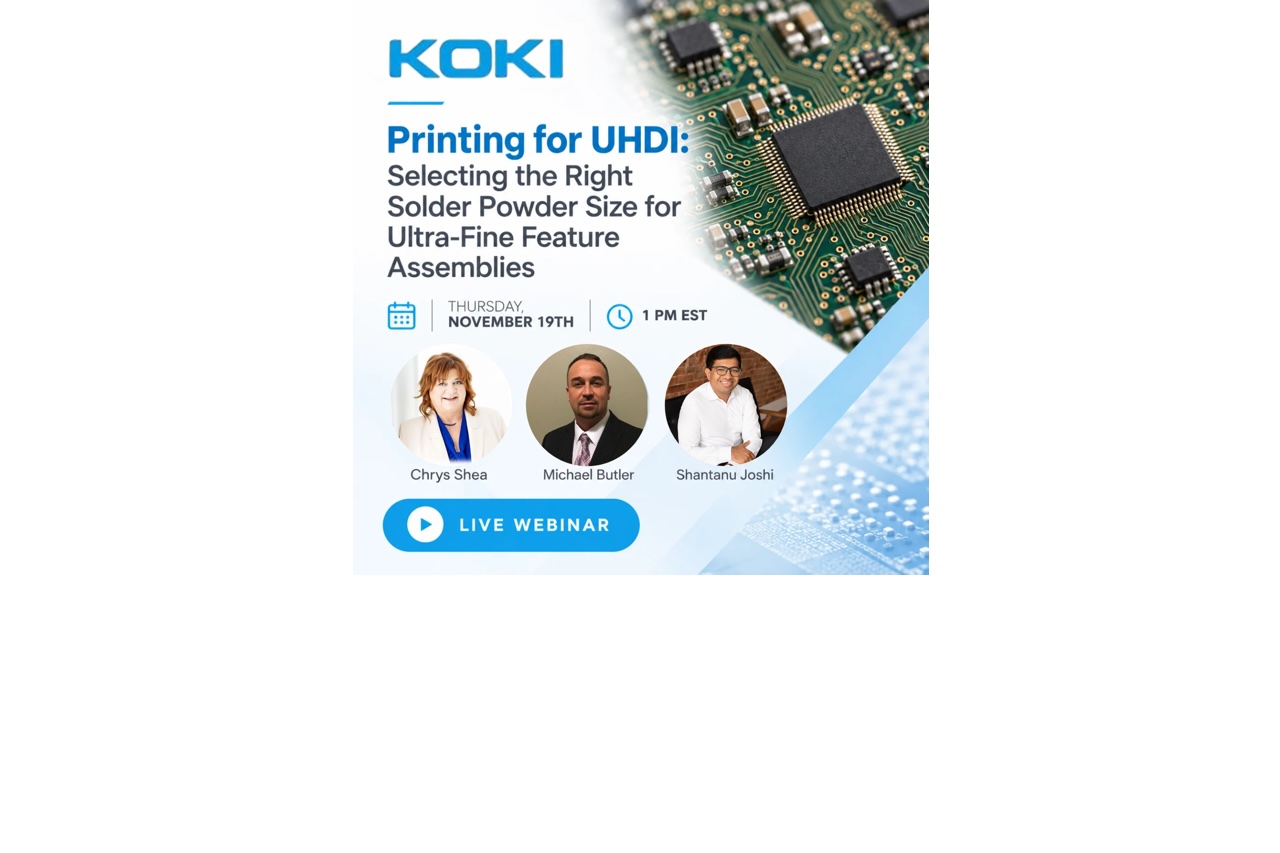
KOKI Solder America will host a technical webinar, “Printing for UHDI: Selecting the Right Solder Powder Size for Ultra-Fine Feature Assemblies,” on Thursday, November 19, 2026, at 1:00 PM ET. Presented in collaboration with SHEA Engineering Services and PARMI USA, the webinar will examine the challenges of solder paste printing for Ultra High Density Interconnect (UHDI) assemblies and share findings from a comparative study of Type 4, Type 5 and Type 6 solder pastes.
As electronics manufacturers move toward smaller components, finer pitches and increased circuit density, maintaining consistent solder paste deposition becomes increasingly difficult. Reduced stencil aperture dimensions can introduce challenges with aperture filling, paste release, transfer efficiency and print repeatability. These issues can contribute to insufficient solder deposits, inconsistent print volumes and downstream assembly defects.
While finer solder powder types are often considered for ultra-small apertures, selecting the appropriate powder size requires more than evaluating particle dimensions alone. Stencil area ratio, aperture geometry, component orientation and board design characteristics can all influence print performance. Understanding how these variables interact is essential for establishing reliable printing processes as feature sizes continue to decrease.
During the webinar, Shantanu Joshi of KOKI Solder America, Chrys Shea of SHEA Engineering Services and Michael Butler of PARMI USA will present findings from a UHDI printing study evaluating Type 4, Type 5 and Type 6 solder pastes. The investigation uses a challenging test vehicle incorporating passive components ranging from 0201 down to 008004, along with BGA features with pitches ranging from 0.5 mm to 0.3 mm.
Using solder paste inspection (SPI) data, statistical analysis and production-relevant testing methods, the presenters will examine how powder size and design variables influence print quality and repeatability. The discussion will also address where conventional stencil area ratio guidelines begin to reach their practical limits and how engineers can use measured print performance to inform material and process decisions.
Key technical topics will include:
- The influence of solder powder size on aperture filling, paste release and transfer efficiency
- Considerations for selecting Type 4, Type 5 or Type 6 solder paste for ultra-fine feature applications
- The relationship between stencil area ratio and printing performance as aperture dimensions decrease
- The effects of component orientation, aperture location and board design on print consistency
- The use of SPI measurements and statistical methods to evaluate print capability
- Practical considerations for optimizing solder paste selection and stencil design to support UHDI manufacturing
The webinar is intended for SMT process engineers, manufacturing engineers, PCB design engineers, NPI teams, quality and reliability professionals, and others involved in developing or optimizing electronics assembly processes.
Register now to reserve your spot: https://meet.zoho.com/unan-fut-znw
About KOKI
Founded in 1964, KOKI leads in advanced soldering materials, emphasizing innovation, sustainability, and compliance. Beyond products, KOKI provides comprehensive technical support, including analytical services and process optimization, to help customers improve manufacturing yield, reliability and performance. With a global focus, KOKI continues to set new standards in soldering technology and customer support.