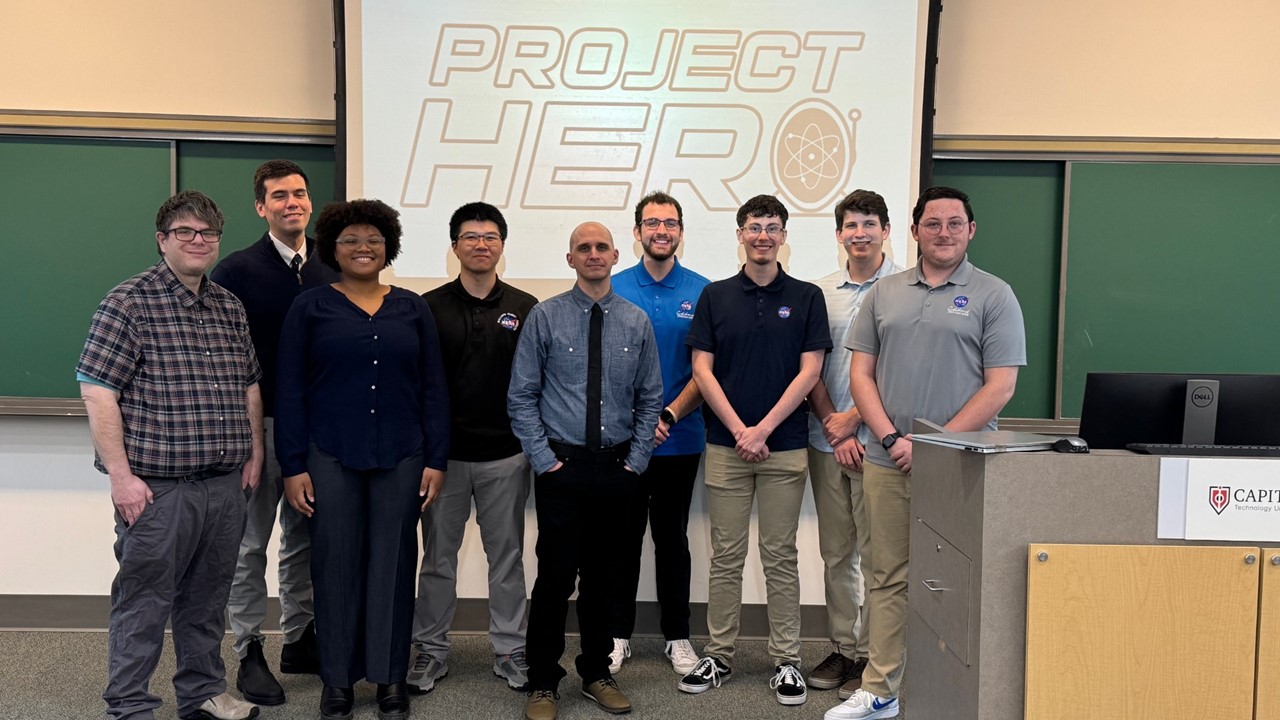
Capitol Technology University continues to advance its RockSat sounding rocket payload, Observation & Detection Interpreted by Neural-networks (ODIN), following its selection by NASA for a June 2026 sounding rocket mission. The payload was chosen based on the strength of its scientific objectives and the technical maturity of its design, successfully completing two NASA design reviews and progressing toward flight readiness.
With support from The Test Connection, Inc. (TTCI), Capitol Technology University is strengthening its RockSat program through industry-led reviews of design, fabrication, and assembly, along with electrical testing conducted prior to final assembly reviews. This collaboration helps ensure the payload meets the rigor and reliability expectations required for spaceflight hardware.
ODIN is being developed by a multidisciplinary student team representing Astronautical Engineering, Data Science, and Computer Science. Working collaboratively, the team is building an advanced spaceflight payload that applies artificial intelligence to interpret science data during flight and dynamically prioritize data for transmission.
The payload integrates an X-ray camera, a gamma-ray spectrometer, an onboard neural-network AI system, and a custom Iridium satellite communications downlink. This architecture enables near-real-time visibility of mission data on campus, presented through a live dashboard designed and implemented by the student team.
A defining feature of ODIN is its use of AI to perform real-time data analysis within the constraints of limited spaceflight bandwidth. By evaluating data during flight and selecting the most valuable information for downlink, the system demonstrates an innovative approach to operational AI in space environments.
TTCI serves as the industry liaison for the ODIN project, providing guidance on system integration, test strategy, and mission-readiness considerations. The partnership highlights the value of industry engagement in helping student teams meet the standards required for aerospace flight programs.
“We’re proud to work with emerging engineering talent and help shape the next generation of professionals entering our industry,” said Bert Horner, President of The Test Connection, Inc. “Projects like ODIN give students exposure to real-world expectations, disciplined engineering processes, and the level of rigor required for successful flight hardware.”
Additional technical and standards-based support is provided through The Training Connection LLC, TTCI’s sister company, with a focus on manufacturing quality and design discipline critical to spaceflight success.
“Introducing young engineers to IPC-driven design, manufacturing, and quality control helps them understand what it truly takes to succeed in flight hardware,” said Bill Graver, Master Instructor Trainer (MIT) and Technical Liaison for The Training Connection LLC. “Applying IPC principles early improves reliability, reduces risk, and significantly strengthens a project’s readiness for flight.”
Through participation in the RockSat program, students gain hands-on experience with NASA-style design reviews, mission-critical system development, AI-enabled data processing, and real-time telemetry and communications—preparing them for careers in aerospace, defense, data science, and advanced electronics engineering.
As the ODIN payload progresses through final design, integration, environmental testing, and launch preparation, The Test Connection will share updates highlighting key technical milestones and student achievements on the path to flight in 2026.
To learn more about Capitol Technology University, visit www.captechu.edu.
For more information about TTCI, visit www.ttci.com.