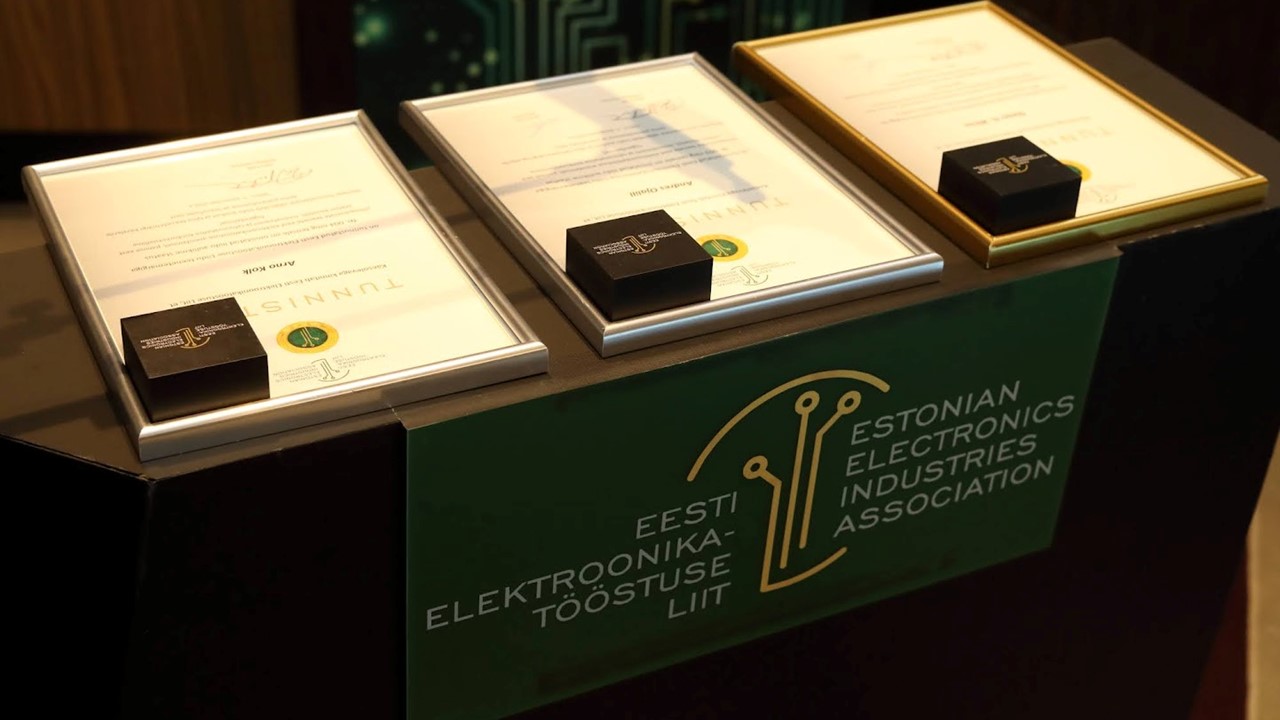
On December 5th, the Estonian Electronics Industries Association (EEIS) awarded its Honorary Badge for the first time to four individuals whose exceptional contributions have helped shape Estonia’s electronics industry: Andres Taklaja, Dieter Weiss, Andres Ojalill, and Arno Kolk. The Honorary Badge is the Association’s highest form of recognition, granted to individuals whose work has significantly influenced the development and international standing of Estonia’s electronics sector.
According to Otto Pukk, Chairman of the Estonian Electronics Industries Association and President & CEO of Incap Corporation, establishing the Honorary Badge was a natural step for the Association. “The strength of Estonia’s electronics industry lies in the people whose dedication, expertise and vision have built a sector capable of competing at the European level. Our aim is to highlight and honour these individuals,” Pukk explained.
He added that each recipient’s contribution is of great importance. “Their impact goes beyond the boundaries of individual companies or organisations. They have helped steer the direction of the entire sector and built a strong, knowledge-based foundation for future generations of professionals,” Pukk said.
Andres Taklaja (posthumously) played a decisive role in founding EEIS. He served as the Association’s first Chair of the Board and, as head of the Radio Engineering Institute at Tallinn University of Technology, played a crucial role in educating radio engineers. As the founder of Rantelon, he also contributed significantly to the development of Estonia’s electronics industry and national defence. Honorary Badge No. 1 will be preserved in the Association’s archives, and Taklaja has been named an honorary member of EEIS.
Dieter Weiss is one of the most influential experts in Europe’s EMS sector. His work has deepened understanding of the strategic importance of electronics manufacturing in Europe and helped increase international awareness of Estonia’s electronics industry.
Andres Ojalill has played a key role in implementing IPC standards in Estonia — both in industry and in vocational education. Under his leadership, Estonia’s first IPC training and certification centre was established, and several essential standards were translated into Estonian, supporting higher quality and greater international competitiveness in the sector.
Arno Kolk received the Honorary Badge for long term leadership shaping the Estonian electronics sector, for growing EEIS into a strong community of nearly 90 members, for advancing engineering education and talent development and for building networks that connect companies, universities and international partners.
The Honorary Badge is the highest recognition granted by the Association and is awarded by decision of the EEIS Council. Recipients are also granted honorary membership.
The badges were presented at the international seminar “EMS & Beyond 2025,” now in its eighth year, which brought together 230 participants from 19 countries. The seminar focused on the competitiveness of Europe’s electronics industry and the future of its value chain. Topics included the growing role of Central and Eastern Europe in global electronics, EMS sector challenges, the sustainability of PCB manufacturing in Europe, and the geopolitical shifts affecting supply chains and market dynamics. Speakers included international analysts, industry experts, and Estonian sector leaders.
The seminar was supported by the City of Tallinn, Incap Corporation, In4ma, Data4PCB, Luminovo, the Global Electronics Association, TLT PCB, and Avnet.
To learn more, visit www.estonianelectronics.eu.