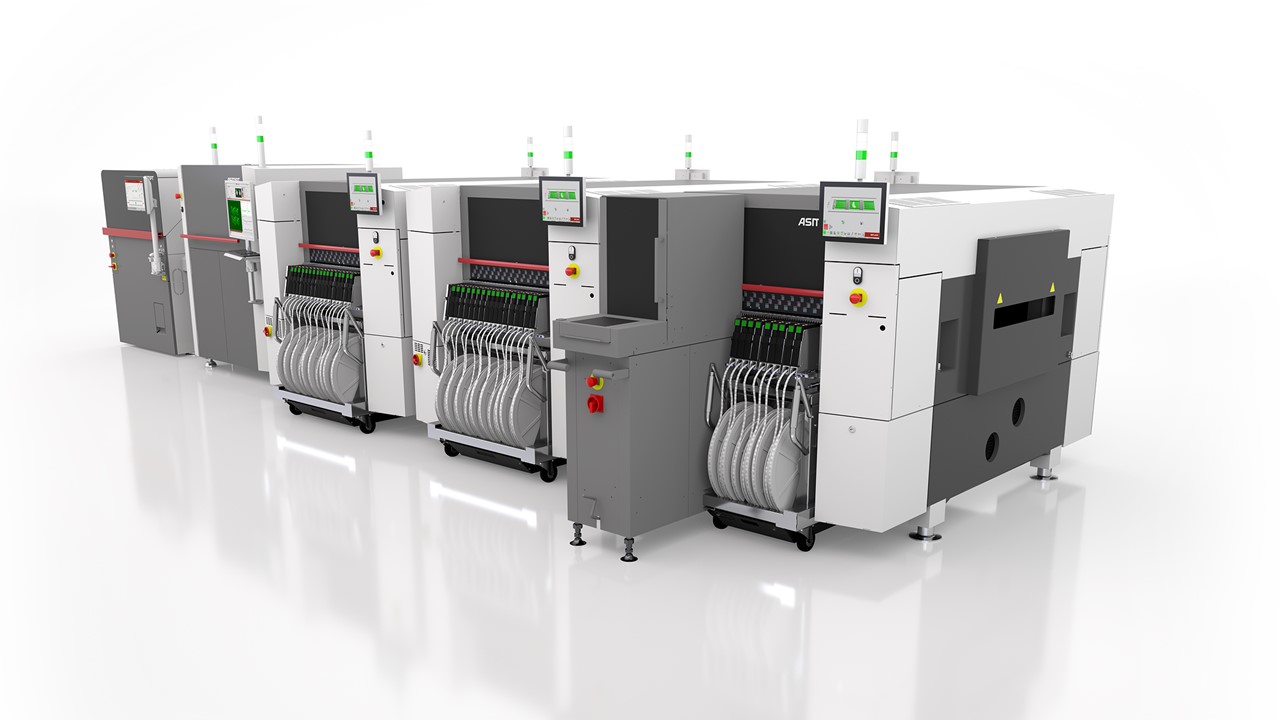
AI servers pose a new set of challenges for SMT production operations. Ever larger and heavier ball grid arrays (BGAs) with tens of thousands of balls, oversized circuit boards and extremely high component density require stable SMT manufacturing processes. ASMPT SMT Solutions shows that these requirements can be met already today with the proven SIPLACE SX placement platform and end-to-end inline quality controls.
“The server boards for AI applications are significantly larger and heavier than conventional circuit boards and feature high population densities on both sides. The processors – whether GPU, TPU or CPU – are typically placed directly onto the server boards as ball grid arrays (BGAs) in the form of highly integrated multi-die modules. This poses completely new challenges for the SMT manufacturing process,” explains Petra Klein-Gunnewigk, Senior Product Manager Placement Solutions at ASMPT SMT Solutions. “And since the AI processors are so expensive, the entire placement process must operate with the highest degree of reliability.”
Seamlessly coordinated technologies
Modules measuring up to 150 × 150 millimeters and weighing more than 500 grams are no longer the exception, with even larger and heavier components being foreseeable. At the same time, the number of connections continues to grow. Together with ICs, QFNs, electrolytic capacitors and thousands of highly miniaturized passive components, a single circuit board may have more than 20,000 placement positions. In addition, the passive components must be placed with great precision not just in high densities, but often in varying angular positions. To meet these requirements, the SIPLACE SX can be equipped with the CP20 collect-and-place head. With 20 separately operating segments, it enables offset corrections and the high-precision assembly of even densely placed components in any angular position within a single head cycle. For large and heavy processor BGAs, the TWIN VHF placement head is available. It uses nozzles that
are specially designed for the respective component. The system also determines the inertia of each BGA and takes it into account during the program generation so that even heavy components can be processed safely and reliably. Programming is done with the WORKS Software Suite, into which the BGAs’ geometry data can be imported. The PCB handling is also designed to meet these special requirements. Heavy-duty conveyors carry PCBs weighing up to ten kilograms safely through the assembly process. And the SIPLACE Smart Pin Support positions the support pins automatically and continuously monitors them to keep large circuit boards from warping.
Machine-integrated quality control
Suitable vision systems are already available for the critical control steps. This makes it possible to inspect all BGA connectors with high-resolution cameras before the placement. With the On-board PCB Inspection software option, the placement area can be 3D-checked for contaminants immediately before the BGA gets placed. Another crucial quality factor is the coplanarity of large BGAs. Only if all balls are perfectly level can their reliable contact with the solder paste be guaranteed. To accomplish this, a 3D coplanarity measurement system with laser triangulation is used that features vertical resolutions of up to 0.5 µm.
“The demands on the production of AI server boards are currently increasing rapidly. Therefore, it is not a single technology that makes the difference, but the precise interaction of all process steps – from the component description, the PCB handling and material supply operations to the in-machine inspection, the BGA placement and the coplanarity check. Since the SIPLACE SX combines these functions in a single platform already today, it offers the prerequisites for the stable and reliable production of highly complex AI server boards,” says Petra Klein-Gunnewigk.
To learn more about ASMPT, please visit www.asmpt.com.