Market Summary
According to latest research by Growth Market Reports, the global Cobots in Electronics market size reached USD 1.47 billion in 2025, reflecting robust and accelerating adoption across the electronics manufacturing sector worldwide. The market is projected to expand at a CAGR of 18.7% from 2026 to 2034, reaching a forecasted value of USD 7.22 billion by 2034. This remarkable growth is primarily driven by the electronics industry’s escalating demand for flexible automation, enhanced productivity, and improved workplace safety, as companies increasingly deploy collaborative robots (cobots) to optimize their production lines and address persistent labor shortages.
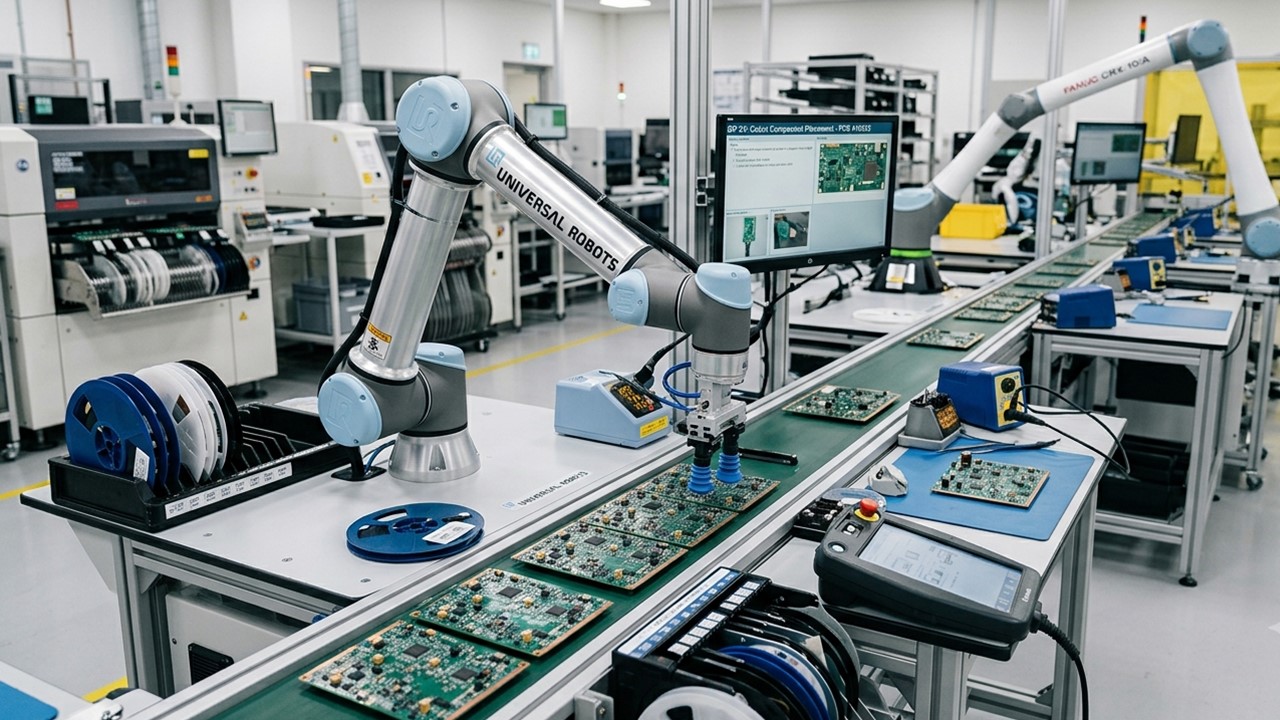
The Cobots in Electronics Market is witnessing remarkable momentum as electronics manufacturers increasingly adopt collaborative robots to improve productivity, precision, and workplace safety. Unlike traditional industrial robots, cobots are designed to work alongside human operators, making them ideal for complex electronic assembly, inspection, testing, and packaging tasks. Their flexibility and ease of deployment are transforming production environments across consumer electronics, semiconductors, telecommunications equipment, and other high-tech manufacturing sectors.
Growth Drivers
Growing Demand for Precision Manufacturing
Electronics manufacturing demands exceptional accuracy due to the miniaturization of components and increasingly sophisticated product designs. Cobots deliver consistent precision while minimizing production errors, making them highly valuable for assembling printed circuit boards, installing micro-components, soldering, and quality inspection.
Their advanced sensors and intelligent programming enable them to perform repetitive operations with remarkable consistency while allowing human workers to focus on more complex decision-making tasks. As manufacturers strive to improve product quality and reduce defects, collaborative robots continue to gain widespread acceptance.
Industry 4.0 Accelerates Market Expansion
The rapid adoption of Industry 4.0 technologies is one of the strongest growth drivers for the Cobots in Electronics Market. Modern production facilities are integrating artificial intelligence, machine learning, industrial Internet of Things (IIoT), and cloud-based monitoring systems with collaborative robots to create intelligent manufacturing ecosystems.
These connected production environments enable real-time data analysis, predictive maintenance, and optimized production scheduling. Cobots seamlessly fit into these digital factories by collecting operational data while adapting to changing production requirements without extensive reprogramming.
Labor Challenges Encourage Automation
Many electronics manufacturers face persistent labor shortages, increasing wage pressures, and the need for highly skilled technicians. Cobots offer an effective solution by supporting human workers rather than replacing them entirely.
Their user-friendly programming interfaces allow operators with minimal robotics experience to configure new tasks quickly. This reduces training requirements while improving operational flexibility. Manufacturers also benefit from reduced workplace injuries since cobots handle repetitive, physically demanding, or ergonomically challenging tasks.
Challenges Remain Despite Strong Growth
Despite promising opportunities, several factors continue to influence market adoption. Initial investment costs remain relatively high for small and medium-sized manufacturers. Integrating collaborative robots into existing production systems may also require infrastructure upgrades and employee training.
Cybersecurity concerns surrounding connected manufacturing environments are becoming increasingly important as factories adopt cloud-enabled automation platforms. Companies must ensure secure communication between robots, production equipment, and enterprise software systems.
Nevertheless, declining hardware costs and improving return on investment are making cobots more accessible to manufacturers of all sizes.
Technological Innovations Improve Performance
Continuous technological advancements are making collaborative robots faster, smarter, and more versatile. Artificial intelligence enables cobots to recognize objects, adjust movements automatically, and detect product variations during assembly.
Enhanced vision systems, force sensors, and machine learning algorithms allow robots to perform increasingly sophisticated tasks with minimal human intervention. Wireless connectivity and remote monitoring further improve operational efficiency by enabling predictive maintenance and reducing equipment downtime.
Manufacturers are also introducing modular cobot platforms that can be rapidly reconfigured for different production lines, supporting greater manufacturing flexibility.
Competitive Landscape
Universal Robots
ABB Ltd.
FANUC Corporation
KUKA AG
Yaskawa Electric Corporation
Techman Robot Inc.
Denso Corporation
Omron Corporation
Epson Robots
Doosan Robotics
Future Outlook
The future of the Cobots in Electronics Market appears highly promising as electronics production becomes increasingly automated and digitally connected. Growing demand for consumer electronics, electric vehicles, advanced semiconductor devices, and communication technologies will continue driving investments in collaborative automation.
Future developments are expected to focus on greater artificial intelligence capabilities, autonomous decision-making, improved human-robot collaboration, and seamless integration with digital manufacturing systems. These innovations will further enhance production efficiency while supporting sustainable manufacturing practices.
Source: https://growthmarketreports.com/report/cobots-in-electronics-market